
A comprehensive background on what we mean by the Systems of Parkinson's Disease can be found in the scoping document for this project:
Peter Wellstead, "A system's approach to Parkinson's Disease - a working paper", 2008.
[PDF].
History
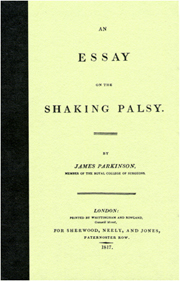 In 1817 the London doctor James Parkinson wrote the pamphlet, "An Essay on the Shaking Palsy" (pictured right) which became famous as the first account of a previously unclassified condition. Sixty years later the famous French scientist and founder of modern neurology, Jean Martin Charcot, coined the term Parkinson's Disease (PD) and linked Parkinson's observations to neurology. Charcot's crucial work was later clarified by Sherrington who showed that PD was related to changes in certain areas of the brain. In the 1960's Carlsson showed that a lack of dopamine in the substantia nigra was implicated in PD. Later in the 1970's environmental toxins and contaminated recreational drugs were linked with Parkinson-like symptoms. Results in the 1990's from genetic studies of families with a history of inherited Parkinson's Disease implicated mutations in certain genes, including alpha synuclein. Subsequently, the protein alpha synuclein was found to be a main component of protein agglomerations, called Lewy Bodies, in the brains of victims of the sporadic/idiopathic form of Parkinson's Disease.
On the basis of alpha synuclein deposits found in Parkinson's sufferers, Braak and his colleagues proposed a staging theory in which the disease enters via the brain stem and progressively moves through the brain, eventually reaching the substantia nigra and finally the cerebral cortex.
[Top]
Treatments
Althought the causes of Parkinson's Disease are far from being fully understood, there are two approaches to treatment of the symptoms - pharmacological and electrochemical.
Carlsson’s work gave a biochemical basis for the physiological symptoms of PD  and led to the first effective treatment using Levadopa (Stalevo for PD treatment pictured right). This drug passes through the blood-brain barrier and is metabolised into dopamine, thus supplementing the depleted intrinsic supply. Levadopa was followed by drugs that attempt to make best use of existing dopamine in the brain by sensitising the dopamine receptors in brain cells, and drugs which inhibit the breakdown of dopamine in the brain. Pharmacological treatment based on dopamine replacement/retention is the foundation of treatments for PD.
Brain surgery, although abandoned in the 1970's because of the highly effective pharmacological results and a reaction against psychosurgery, arose again as an alternative to drug treatment in the late 1980's. This rebirth was guided by a better understanding of the brain circuit and positive results from experiments using electrical stimulation as a treatment for brain disorders. Since then, there have been significant advances in our understanding of Deep Brain Stimulation (DBS), and the technique has grown in popularity as an effective, yet reversible, alternative to surgical lesioning. Specifically, in Parkinson's Disease remarkable results have been shown in which the electrical stimulation of some parts of the basal ganglia (such as the subthalamic nucleus) can dramatically reduce Parkinsonian tremors and restore normal motor function. Despite the advances in applying this technique, fundamental questions remain about the mechanisms involved in DBS.
[Top]
Information & Resources
We are researchers from the physical/engineer sciences and applied mathematics who are developing novel systems approaches to Parkinson’s Disease. We study Parkinson's Disease using methods developed for the study of complex interactions in technological systems, thus we do not claim to be a general source of medical and biological information. There are however a number of organisations that offer this kind of resource and address the concerns of sufferers and carers.
In the EU they include The Parkinson’s Disease Society and the European Parkinson's Disease Association. Parkinson's Disease in the USA is represented by a number of charitable organisations. A useful site is: www.parkinson.org. For research, the charitable organisations mentioned above are a useful source of information. In addition, the USA National Institute of Health supports PD research via Morris K. Udall Centers of Excellence for Parkinson's Disease Research (more information).
[Top]