


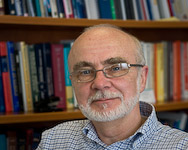
|
|
Peter Wellstead SFI Research Professor Hamilton Institute |
|
Background
|
Born and educated in
Hertfordshire, England. Apprentice in mechanical and electrical trades
with Marconi Instruments for eight years. Later becoming a student
apprentice and part-time
student at Hatfield
College of Technology (now Hertfordshire University). Awarded the De
Havilland Prize (named for the aviation pioneer Sir
Geoffrey De Havilland – whose company was based in
Hatfield) and graduated with BSc 1st class
Honours in Electrical Engineering. From 1967-1970 he studied at Warwick
University School of Engineering Science for the degrees M.Sc (Control
and Systems), PhD (Engineering Science). During his PhD research he
developed methods for closed loop frequency response identification [1], characterised aliassing in
frequency response estimates, [2]
and a multi-sine synthesis method for pseudo random test signals as an
alternative to the then standard PRBS approach [3].
Both closed frequency response estimation and multi-sine techniques are
now standard in signal processing instruments and system identification. As a Technical Fellow at CERN
(1970-1972) he worked with one of the most innovative computer
scientists of the day, Gordon Brandon, in the computer control and
digital signal processing group of the bubble chamber division.
Together they developed the first real time feature recognition system
for digitised bubble chamber photographs. At the time this form of real
time, on-line signal processing was in its infancy , and the CERN group
pioneered real time methods for this problem. In 1972 he joined the staff
of the Control
Systems Centre, UMIST, as a lecturer, becoming Professor of
Control Engineering in 1990 and Head shortly thereafter. The Control
Systems Centre was one
of the first UK postgraduate centres for interdisciplinary control
engineering research, control systems analysis and its applications.
His first scientific work at UMIST was to develop with Francisco
Carvalhal (seconded from the National Civil Engineering Laboratory
(LNEC) of Portugal) real
time adaptive spectral equalisation algorithms for vibration testing.
This system was later implemented at LNEC
as part of their earthquake testing system for civil and engineering
structures, and implemented commercially by vibration control system
manufacturer Solartron. Francisco is now a senior scientific
administrator in Lisbon. The global stability properties of this form
of adaptive system was later derived by Martin Zarrop [4]. In the area of system
identification he worked on fast algorithms [5]
and maximum likelihood methods [6]
for parametric system identification with Allan Robins and Denis Prager
and developed the instrumental product moment test structure testing
method [7]. System
identification application ‘firsts’ by his group
are the dynamical identification an
automotive gas turbine (with CAV Ltd) for multivariable control,
estimation of the vertical motion dynamics of the Joint European Torus,
and the wave energy device known as Salter’s
Duck. The work on adaptive shaping
of closed loop test spectra, combined with interest in the sensitivity
issues of minimum variance control methods led to collaboration with
John Edmunds and other research students to develop the theory and
application of the Pole Assignment Self – Tuner, [8]. Later with research student,
Denis Prager, he developed the MIMO version of the same algorithm [9].
Self-tuning application ‘firsts’
by his group include a digital self-tuning diesel engine regulator
(with CAV Ltd), self – tuning super-heater control (with
CEGB) and a low cost, portable self-tuning instrument.
Pole assignment is now a standard textbook technique
for adaptive control. He had a fruitful
relationship with Lucas Automotive Research and was appointed the Lucas
Professor of Automotive Control as a result. A highlight of this twenty
year period of collaborative research was the development, with Peter
Scotson, of a Self-Tuning Extremum Control method for gasoline engine
spark angle optimisation[10].
This method was patented and used by Lucas and its derivative
companies. In addition to general automotive control research, his
research group also developed methods for hybrid systems found in
automotive applications. These methods were used to analyze problems in
rule based control of ABS brake control and thus save valuable track
testing time [11]. As a result of the
collaboration with Lucas Automotive, 15 PhD and MSc
graduates from UMIST joined the Lucas Research
Centre and formed the core of Lucas’s control and systems
technology expertise. A number of these engineers remain and have
influential positions in the automotive research sector with TRW Inc. His work on
self-adaptive/self-tuning algorithms continued with the development of
Two-Dimensional (2-D) predictor algorithms and their dual 2-D minimum
variance control methods [12].
These 2-D control methods found application in the area of sheet
manufacturing systems, such as paper making [13]
and plastic film extrusion, and he was given a Royal Society
Industry Fellowship to develop the applications of the theory
in the film extrusion area. Traditionally paper machine wet end control and film extrusion has
been treated as a conventional control problem. The Control Systems
Centre group are credited with changing this viewpoint and introducing
the 2-D paradigm to the sheet product manufacturing area. Experience with practical
film extrusion led to two new bodies of work: The first concerned 2-D
sensing, [14]. In particular,
the signal processing of 2-D data when the 2-D surface is scanning in a
sparse way – as with a scanning sensor. This work with
colleagues Steve Duncan, Martin
Zarrop and Jim Skelton, led to the application of Generalised Sampling
Theory to the reconstruction of 2-D surfaces from sparse (scanned )
data, and new methods for reconstructing full sheet information from
conventional scanning gauges [15].
Steve Duncan and his group has since generalised the 2-D sensing idea
to actuation [19]. The second body of work was
the result of collaboration with the eminent NIR instrument designers
and scientists, Roger Edgar and Peter Hindle on a portable and robust
form of the classical Michelson
interferometer so that the NIR spectrum of light from a product could
be measured and analysed in real time. This led to the invention, again
with John Edmunds, of new active control methods for two-beam
interferometers. With first round funding from Manchester Technology Fund
, he and a team of UMIST colleagues developed the Active
Control Interferometer technology into a compact portable NIR
spectrometer. A company, Acimetrics, has since been incorporated to
develop and commercialise the ACI technology. The application sectors
are industrial real-time non contact measurement of organics, and in
the medical sector – high throughput, non-invasive
measurement and analysis of blood and tissue contents. He has writtenreports page of the systems biology group) text books on
Systems Modelling [16] and
Self-Tuning Control [17],
directed 23 government research grants, and supervised over 90 MSc and
30 PhD research students. He co-founded and directed a Contrreports page of the systems biology group)ol
Technology Transfer Network for the North of England. Over its 6 year
life the Network managers, Steven Schooling and Lita Denny, assisted
over 30 companies and developed the core technology for a
‘start-up’ company working on battery and corrosion
cell testing. As an educationalist his
passion is for learning through practical experience, in particular the
use of scale models of real systems for teaching systems dynamics,
modelling and control. Based on the concept that students should deal
with real systems, not simulations, he and
Roy Moody (Chief Technician in the Control Systems
Centre), developed in the 1970’s and 1980’s a range
of scale model systems from different application areas of systems
dynamics, and used them to teach Masters and undergraduate students
over a period of three decades.
Products based on his designs now appear in control
laboratories throughout the world ( see Control
Systems Principles). In the community, he is a
former Honorary Editor of the Institute of Electrical Engineers (IEE) Proceedings,
Control Theory and Applications, and serves on a number of committees
and international conference panels. He is a regular mountain
biker but his last vintage motorcycle run was the Banbury
Run with Bill
Geraldine in 2003.
|
Project Photo Gallery
Early
output from the real time bubble chamber
feature recognition programme (circa 1970, CERN
Geneve). The first Coupled Tanks
Apparatus (circa 1975, Control Systems Centre, UMIST) The
Solartron 1200 Signal Processor with closed loop identification and
multi-sine test signal generation (circa 1980, Solartron Instruments) Digital self-tuning diesel
engine speed regulator (circa 1978, Control Systems Centre UMIST with
CAV Ltd) Roy Moody bench testing a steam
engine experiment (circa 1985, Control Systems Centre Teaching
Laboratory) |
|
Current
position: He is Science Foundation
Ireland (SFI)
Research Professor of Systems Biology, based at the Hamilton Institute.
For full details see http://www.systemsbiology.ie/.
Current research interests: Systems
Biology – his personal interest is to contribute to a systems
understanding of Parkinson’s Disease and other
Neurodegenerative diseases. Non-Invasive
Sensing – in particular the use of his ACI technology for
high throughput non-invasive medical and biological measurement. System
Identification [19,20] , Control
System Technologies in the Innovation process, [18,
21] Selected
references: 1. Reference
Signals in Closed-Loop Identification, Int. J. Control,
26, 945-962, 1977 2. Signal
Aliassing in System Identification, Int. J. Control, 22, 3, 1975 3. Pseudo
Noise Test Signals and the Fast Fourier Transform, Electronic
Letters, 11, 10, 1975 4.
Self-Tuning Regulators: Non-Parametric Algorithms, Int. J.
Control, 37, 4, 787, 1983 5. Fast
Algorithms in Systems Identification,
Int. J. Control, 33, 3, 1981 6.
Interactive Maximum Likelihood Estimation,
Int. J. Control, 32, 6, 1980 reports page of the systems biology group)7. An
Instrumental Product-Moment Test for Model Order Testing, Automatica,
14, pp 89-91, 1978 8. Pole
Assignment Self-Tuning Regulator, Int. J. Control,
30, 1, 1979 9.
Multivariable Pole-Assignment Self-Tuning Regulators, Proc.
IEE. 128, pt. D, 1981 10.
Self-Tuning Extremum Control, Proc IEE, Vol. 137,
Pt. D. 3, pp 165-175, 1990 16. Introduction
to Physical System Modelling, Academic Press, London, 1979 17. Self-Tuning
Systems, P.E. Wellstead and M. B. Zarrop,
J. Wiley, London, 1991 Selected
recent references: 18. Control and
systems concepts in the innovation process, IEEE Control
Systems Magazine (Special Section on Control as a Systems Technology),
pp 21—58, December 2003. 19.
Processing data from scanning gauges on industrial web processes,
Automatica, 40, pp 431—437, 2004. 20.
Distortion of web profiles by scanning measurements, Pulp and Paper
Canada, 104:12, pp 81—84, 2004. 21. Systems
modelling in team building and innovation, IFAC Conference Advanced
Control Strategies for Social and Economic Systems, Vienna, September,
2004. 22. A Frequency Domain Approach to Determining the Path Separation for Spray Coating, IEEE Trans ASE, vol 2, 3, pp 233-240, 2005. 23. Active
alignment for two-beam interferometers, Review of Scientific
Instruments, 77 (1), 2006. Selected
Systems Biology references: 24.
Schroedinger’s Legacy, E.T.S. Walton Lecture, Royal Irish
Academy, April, 2005 (see reports page of the systems biology group) 25.
The
Dynamic Systems
Approach to Control and Regulation of Intracellular Networks, FEBS
Letters, 579, pp 1846 – 1853, 2005. 26.
A Systems and
Signal Oriented Approach to Intracellular Dynamics, Biochemical Society
Transactions, 33, 3, pp 507 – 515, 2005. 27. A
Unified Framework For Unravelling
The Functional Interaction Structure Of A Biomolecular Network Based On
S timulus-Response Experiment Data., FEBS Letters, 579, pp 4520-4528,
2005. 28.
Feedback
Medicine: Control Systems Concepts in Personalised, Predictive Medicine
and Combinatorial Intervention.Report (arXiv:q-bio. TO/0603032 v1),
2006. 29. A Plea for
More Theory in Molecular Biology, In Systems Biology -
Applications and Perspective. E.Butcher, P.Bringmann, B.Weiss
(eds.), Springer-Verlag, 2006. 30. From
Regulation, Control and Adaption to the Coordination of Cell Function.
In Regulation. M.Laubichler, H.-J.Rheinsberger,
P.Hammerstein (eds.), for publication in Vienna Series of Theoretical
Biology, MIT Press, 2006. 31. On the Industrialisation of Biology, Catedra Amundson, University of Guadalajara, September 2006 (see reports page of the systems biology group) 33. Control Opportunities in Systems Biology, Plenary Address, IFAC Symposia, CAB 2007 and DYCOPS 2007 (see reports page of the systems biology group)
|