
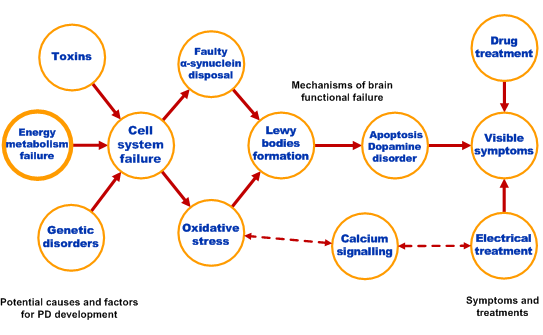
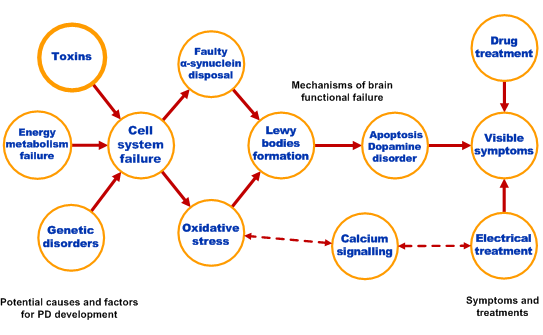
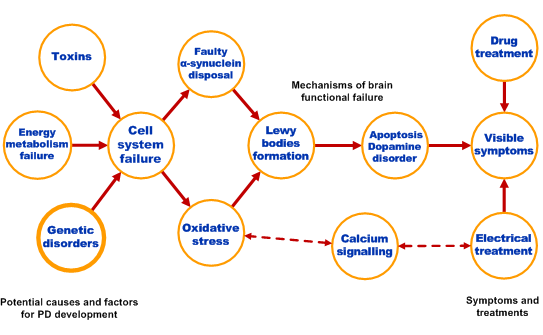
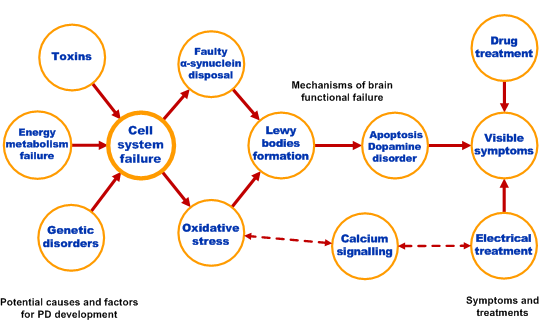
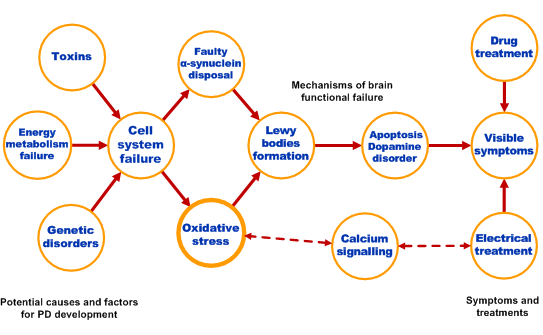
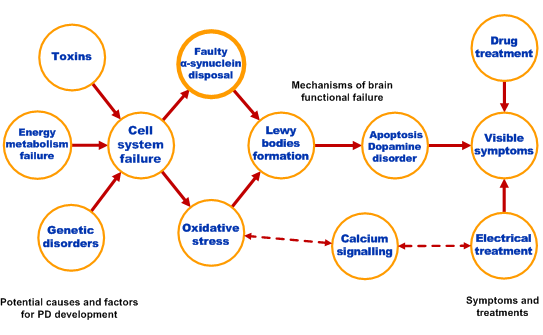
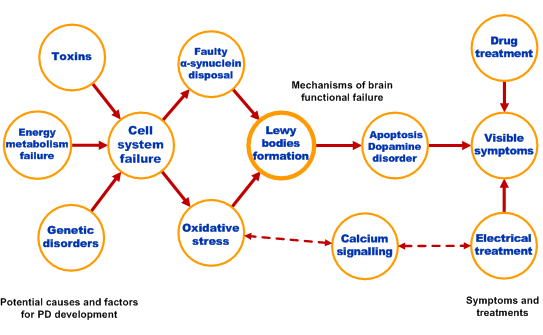
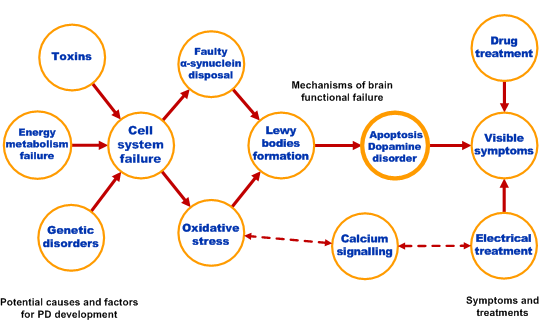
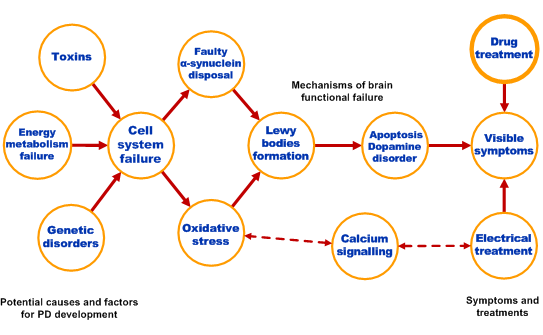
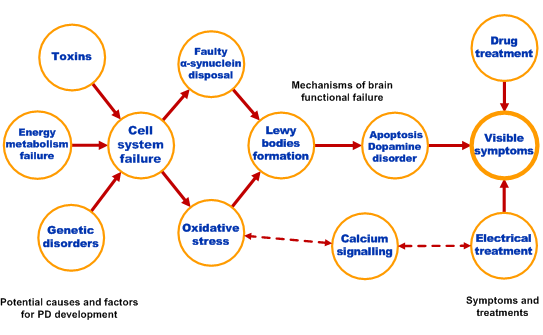

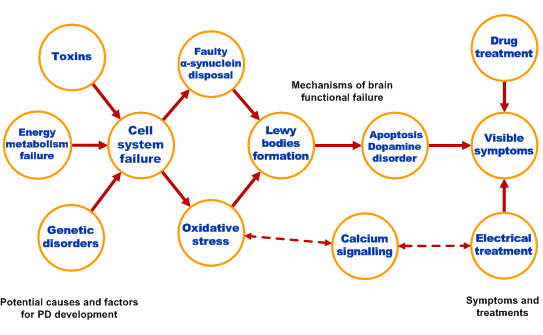
Diagram of the Systems of Parkinson's disease
(click in the designated areas for further information)
Visible symptoms
Overview The disease is progressive, and according to the Braak staging hypothesis, the visible external symptoms develop in its later stages, after the disease has entered the brain via the stem. The disease progresses at different rates and not all victims display the same symptoms. However, the most common visible symptoms are the ‘shaking palsy’ first described by Parkinson in his seminal essay. This loss of control of motor action (caused by dopamine deficiency in the substantia nigra) is accompanied by muscular stiffness, ‘freezing’, stooping, loss of facial expression, slurred almost unintelligible speech and constipation, to mention just a few symptoms. As the disease progresses it is often accompanied by depression, hallucinations, dementia (associated with the formation of alpha-synuclein agglomerations - Lewy Bodies - which disrupt neural communication). The loss of control of bodily function progresses over a number of years and at a variable rate, eventually contributing to death. [Top] |
Selected References Braak, H., Del Tredici, K, Rub, U., de Vos, R. A. I. Jansen Steur, E. N. H. and Braak, E. Staging of brain pathology related to sporadic Parkinson's disease. Neurobiology of Ageing, 2:197-211, 2003. [Top] |