
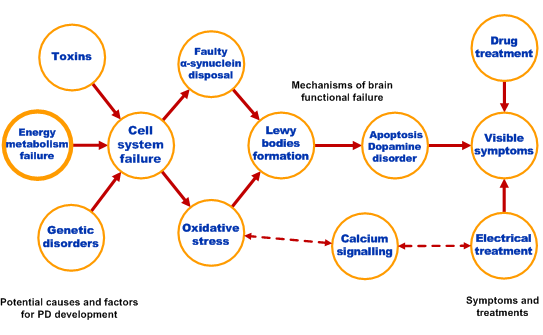
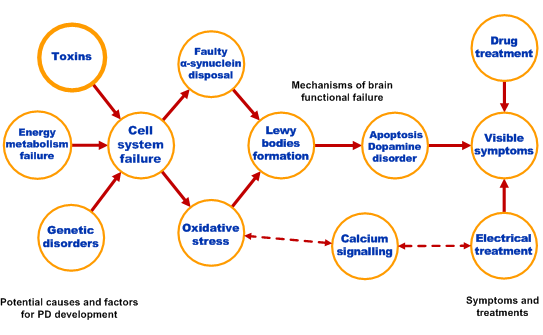
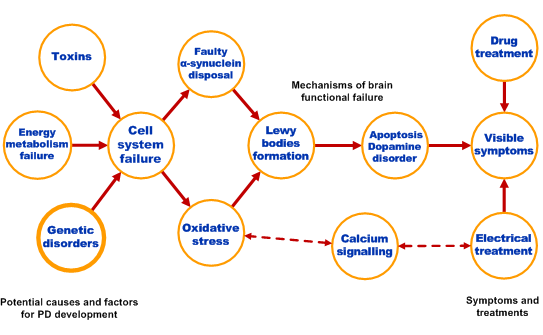
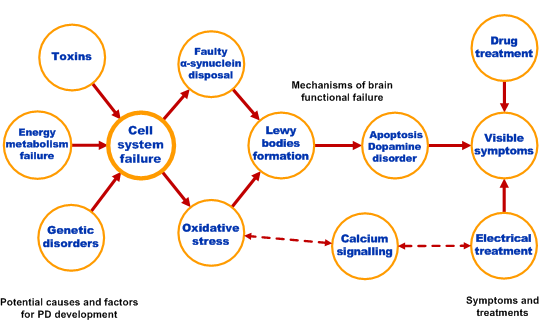
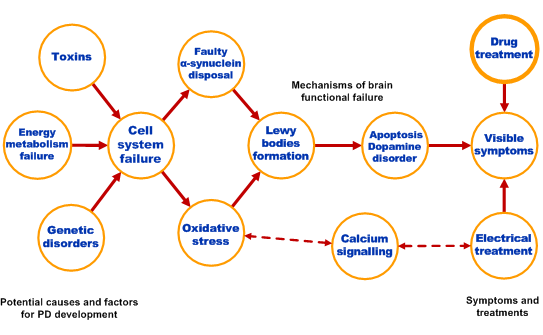
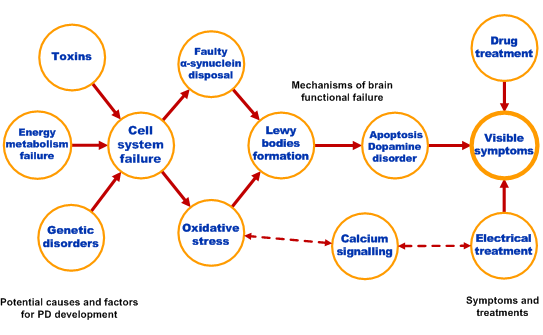

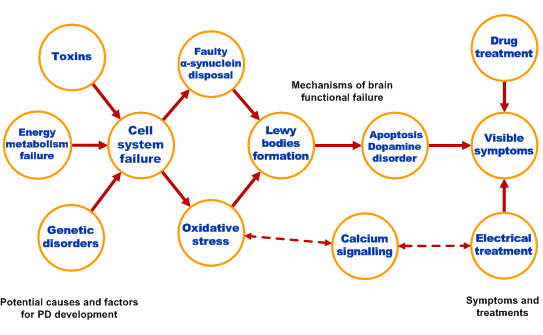
Diagram of the Systems of Parkinson's disease
(click in the designated areas for further information)
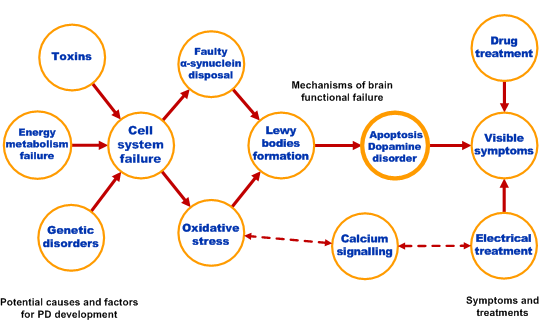
Apoptosis - Dopamine disorder
Overview Scientists have shown that treatment with a toxin that inhibits the ubiquitin-proteasome system causes cells with mutant α-synuclein to be susceptible to programmed cell death (apoptosis). This is accompanied by activation of caspases (cysteinyl-aspartate-specific proteinases) and by injury to the mitochondria. The digestion of cellular organelles and other cell components in the lysomal machinery (autophagy, autophagocytosis) is a normal part of cell growth, development and homeostasis. It forms a mechanism for a starving cell to re-allocate resources and nutrients from non-essential to essential processes. There is a suggestion that apoptotic autophagy may occur in the Substantia Nigra during Parkinson's disease. Moreover, since the dopaminergic neurons are the most affected by the apoptotic processes during PD development, links between cellular apoptosis in a tissue and the loss of dopamine ‘functionality’ in the surrounding area must be sought in order to get a better understanding of how the disease progress. [Top] |
Research Models that describe how programmed cell death can occur are numerous, and as the major signalling pathways are identified, the models diversify. The caspase activation cascade and its interactions with cytochromes (released from mitochondria) is one of these well known pathways (see Figure). However, the regulation and kinetic behaviour of the apoptotic pathway is still being investigated. Especially relevant to apoptosis are the bistability properties, as the pathway must be stable when in a ‘healthy’ state while being able to respond to signals that ‘trigger’ the cell death process. Building upon actual models for apoptosis (Eissing and co-workers, 2004), we aim to develop models for programmed cell death that could be integrated within the brain physiological environment and provide crucial insights on disease development (switching from ‘healthy’ to ‘unhealthy’ behaviour). The description of apoptotic phenomena within a tissue that experience a subsystem failure, coupled with a good description of dopamine metabolism (Qi, Miller and Voit, 2008) will eventually allow us to describe how a local failure (cellular death) might progress and induce visible PD symptoms. [Top] |
Contact point Please contact us for information on how to be listed here. [Top] |
Selected References Qi Z., Miller G. W., Voit E. O.. Computational Systems Analysis of Dopamine Metabolism. PLoS ONE, 3(6), 2008: e2444. doi:10.1371/journal.pone.0002444. Eissing T., Conzelmann H., Gilles E. D., Allgöwer F., Bullinger E., Scheurich P. Bistability Analyses of a Caspase Activation Model for Receptor-induced Apoptosis. J. Biol. Chem., 279(5): 36892-36897, 2004. doi:10.1074/jbc.M404893200. [Top] |