
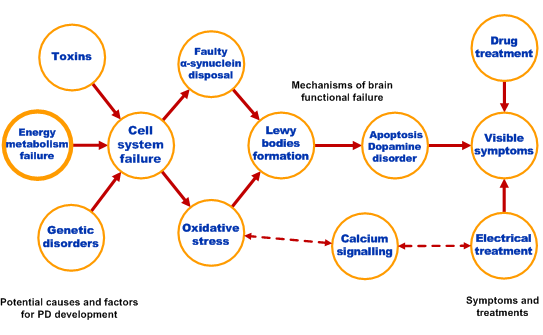
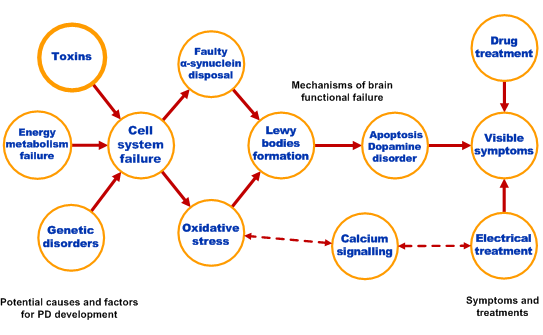
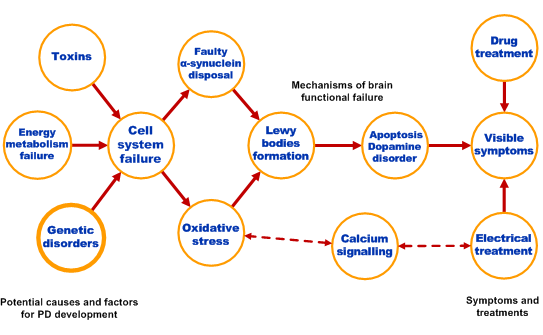
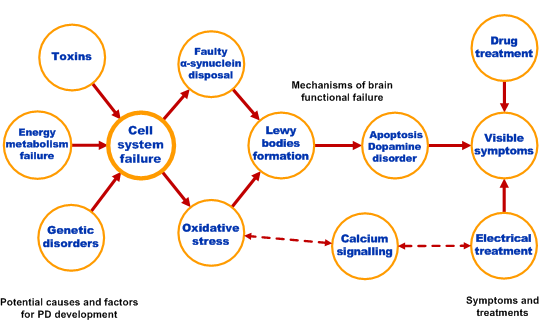
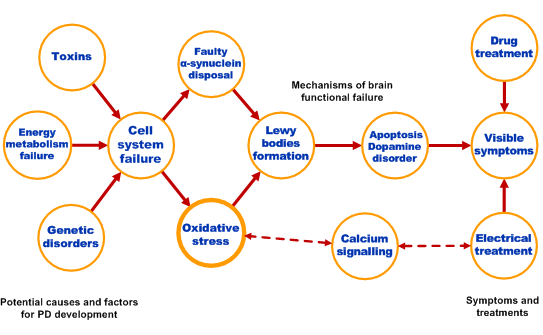
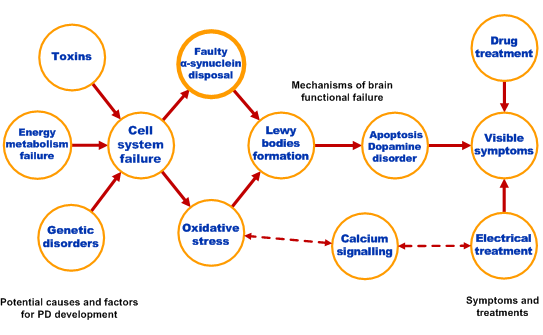
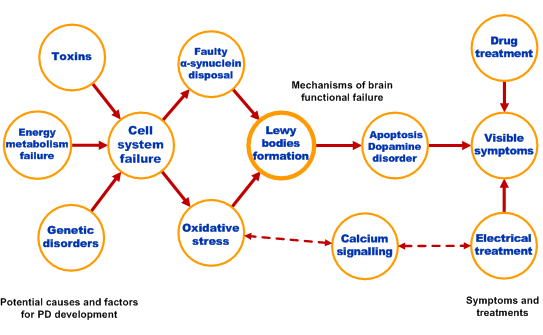
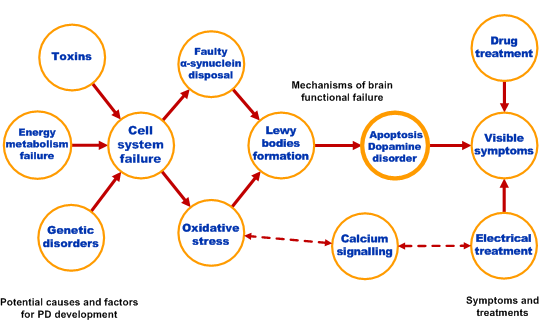
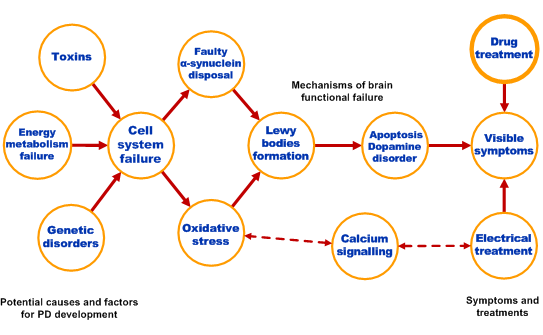
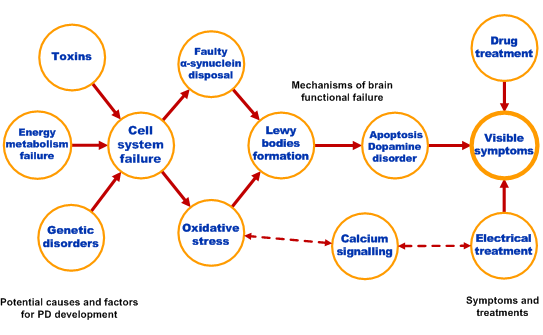

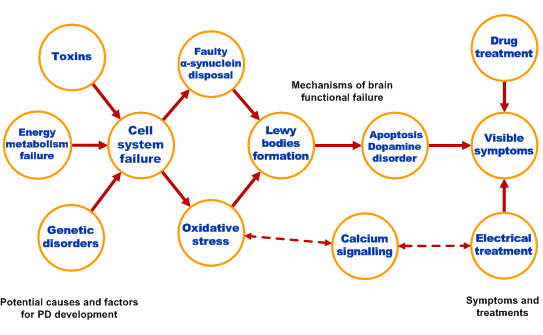
Diagram of the Systems of Parkinson's disease
(click in the designated areas for further information)
Systems of Parkinson's Disease
Overview Parkinson's disease is an example of a complex disease with no single apparent cause (a majority of cases are considered idiopathic), but with a number of implicated cellular and metabolic systems (among which are: genetics, aging, oxidative stress, toxins, nutrition etc.). It thus parallels the multi-factorial defects that occur in complex technological systems. We believe that an integrative study using a Systems Biology approach may help illuminate causal factors of the disease. [Top] |
Research The Systems of Parkinson’s Disease (SoPD) projects takes a systems approach to disease by considering it in the same way that a control systems engineer might analyse faults in a complex technological process. One of the first steps for SoPD will thus be the integration of available knowledge on potential cellular processes failures in the development of the disease. The field of Systems Biology, which is intrinsically multidisciplinary, gives us the opportunity to do so. Knowledge from experimental biology, control engineering, mathematical modelling of biochemical pathways and such will be necessary in order to elucidate the Systems properties of PD development. The central thread by which knowledge integration will be possible is the development of mathematical models for the mechanisms involved in the disease. Building models for biological systems is not an easy task, as the properties of these systems are very well understood at the ‘local’ level, while not that much is known for global cellular regulation and interactions. Nevertheless, we do think that it is possible to integrate relevant knowledge on PD by considering the key mechanisms for cellular systems failure and disease development. These systems include, but are not limited to:
Each of these systems and mechanism are presented in the diagram of the SoPD (see image above). You can click on the subsections to get further information on research possibilities that we do explore or for which we think research could be integrated in the SoPD. [Top] |
Selected References Peter Wellstead and Mathieu Cloutier. A systems approach to Parkinson's Disease. Internal report, 2010. [PDF] Peter Wellstead. A systems approach to Parkinson's Disease - a working paper. Internal report, 2008. [PDF] [Top] |
