

news archive

Hamilton Institute TwinLin project show-cased at Innovation Ireland Colloquium in Berlin

Thursday, May 3rd, 2012

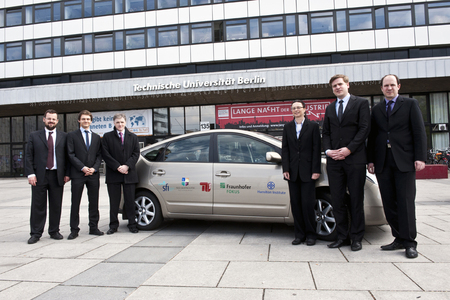
The TwinLin project led by Prof. Robert Shorten of the Hamilton Institute featured at the Innovation Ireland Colloquium held in Berlin on April 25th as an exemplar of Irish-German research co-operation. The project is a partnership between the Hamilton Institute, Fraunhofer Fokus and TU Berlin studying smarter ways to use hybrid electric vehicles to manage pollution in cities. For further details on the TwinLin project, contact Prof. Robert Shorten.


The TwinLin team: Arieh Schlote (HI), Thomas Hecker (Fraunhofer), Robert Shorten(HI), Astrid Bergman (TU Berlin), Florian Hauesler (Fraunhofer), Jens Zech (Fraunhofer)

See also SFI press release.

PhD Scholarship: Mathematics of Future Wireless Networks, Hamilton Institute/Bell Labs Ireland

Thursday, February 2nd, 2012

PhD Scholarship: Mathematics of Future Wireless Networks

Basic Description

Applications are invited for a PhD research position at the Hamilton Institute. The position is sponsored by Bell Labs Ireland, the R&D arm of the Alcatel-Lucent and a major industry research lab based in Dublin. The Hamilton Institute is one of the largest and most active applied mathematics research groups in Ireland and an international centre of excellence.

Wireless networks are not only ubiquitous and of great economic importance to modern society, but also the source of many of the fundamental scientific challenges faced by modern communication networks. A key feature of modern networks is their scale and complexity and at the Hamilton Institute and Bell Labs Ireland we are developing new models to gain insight and understanding of the issues and novel solutions to tackle these challenges.

The successful applicant will be spending time at the Hamilton Institute and the Bell Labs facilities and gain a unique education from leading researchers from both academia and industry, positioning them well for their career development. The Hamilton institute has a very active international visitor programme and provides the opportunity for international and industry exchange visits. Our Network Maths initiative is part of our structured PhD programme where leading international researchers provide specialist postgraduate modules to support our research students.

For more information on the Hamilton Institute and its research activity, please visit www.hamilton.ie .

Candidate Profile

The candidate should hold a good (first-class honours or equivalent) degree in Mathematics, Engineering or a related field and be motivated to tackle challenging research problems.

Stipend

Our postgraduate scholarships are open to Irish, EU and international students and carry a stipend of €18,000 (tax free). To apply, candidates should submit a detailed CV, transcripts of undergraduate grades, motivation letter and the names and addresses of two referees for letters of recommendation to Prof. Doug Leith, email: hamilton@nuim.ie.

The Hamilton Institute is an inclusive, equal opportunity employer.

Science article by Ken Duffy, Hamilton Institute researcher, in the news

Tuesday, January 17th, 2012

A new article by Dr Ken Duffy has appeared in Science:

Activation-induced B cell fates are selected by intracellular stochastic competition Ken R. Duffy, Cameron J. Wellard, John F. Markham, Jie H. S. Zhou, Ross Holmberg, Edwin D. Hawkins, Jhagvaral Hasbold, Mark R. Dowling and Philip D. Hodgkin. Science, Jan 2012.

and has also received wide reporting in the public press, including:

The ultimate fate of a cell is determined mainly by an internal process, contrary to previously held scientific belief that the behaviour of a cell was dictated by external factors – that’s one of the findings of a leading team of international multidisciplinary scientists including NUI Maynooth mathematician Dr. Ken Duffy and published in this month’s Science magazine. This discovery could have significant implications for immunology, in particular our understanding and treatment of autoimmune diseases like Crohns, Coeliac disease, diabetes and rheumatoid arthritis.
In a unique international collaboration between mathematics and medical science, Dr. Ken Duffy from the Hamilton Institute, NUI Maynooth, is the lead author of the study which was completed by an international team including immunologists from Prof. Philip Hodgkin’s Laboratory at the prestigious Walter and Eliza Hall Institute of Medical Research in Melbourne, Australia. The study was supported by the National Health and Medical Research Council of Australia, the Victorian Government and Science Foundation Ireland.

Their research tackled the widely held belief that a cell’s fate was exclusively determined by external cues. Until now, scientists believed that the development of a cell, whether division, death or cellular differentiation into a new cell type, was determined precisely by external factors including the presence of a particular hormone or cell-signaling molecules. This study challenges that belief by showing that a cell’s fate is determined by an internal process, with cells having some control over their own destiny and with external factors providing a probabilistic influence.
The team chose to study immune system B cells, which make antibodies, because they are controllable and can be prompted to expand and change type in response to stimulus. B cells undergo cell development common to many systems including birth, division, differentiation and eventual death, and so the study is representative. It is not, however, possible to say that cells in other parts of the body would react in the same way as that has not yet been determined, but the work proposes a significant mechanism that may be common to other cell types.

Each B cell has the potential to develop in a variety of ways including division, death, production of antibodies and altering the type of antibody it makes. The study showed that the selection of each of these options is consistent with governance by a small internal clock. The ultimate outcome for that cell is determined by which clock fires first. So if the ‘division’ clock completes before the ‘death’ clock, then the cell divides instead of dying. Until now, scientists believed that external signals determined precisely which fate a cell would pursue. The research demonstrates that randomness plays a more significant role in cell behaviour than previously thought and that external signals serve to shape and influence this randomness.

‘The science community will be surprised at the random behaviour of individual cells. Even though the cells in the study were exposed to the same external signals, there was still considerable variation in what happened to each cell,’ said Dr. Duffy.

‘We recreated the conditions required for B cells to develop and then filmed the resulting behaviour. Current teaching says that cells in identical conditions will react in the same way. However, our research shows that the fate of the cell is determined by which clock fires first. The importance of this research is that these clocks can be manipulated by external signals,’ said Dr. Duffy, adding that the research is of great use in understanding the immune system and therefore in determining how to manipulate same to fight infection.

The actual manipulation of the internal cell clocks could potentially be manifested by administering a cocktail of cytokines. These small molecules that float around cells, eventually bind to the cell receptors and induce certain behaviour in that cell. Certain cytokines influence some clocks and not others so by changing the makeup of the cytokine mix, the likely winner of the clock competition can be altered.

The collaboration came about when Professor Phil Hodgkin of the Walter and Eliza Hall Institute of Medical Research in Melbourne, Australia visited NUI Maynooth as a SFI Walton Visitor Professor for a sabbatical in 2007. He gave a lecture which Dr. Duffy attended, detailing deductions from 15 years of study into this area. Dr. Duffy realised that his expertise in mathematical probability would have a significant contribution to make to the work in achieving optimum results from the collected data and so the two began their fruitful collaboration.

The team is now planning to study T cells, the influential immune system cells which fight viruses, to ascertain if the findings are replicated there. Their ultimate aspiration is to help design new immune therapies for autoimmune diseases and improved vaccines.

‘The work of Ken and the international team is an extremely important contribution to the scientific record and its publication in Science this month is well deserved. NUI Maynooth staff and students are tackling important, complex questions in every field of study and that is something which is part of the University’s DNA. Our mathematicians are among the strongest in the world as evidenced by Ken’s leading role on this study’, said NUI Maynooth President, Professor Philip Nolan.

Postdoctoral Fellowship: Mathematics of Wireless Networks

Wednesday, November 23rd, 2011

Applications are invited for a senior postdoctoral position within the networking group at the Hamilton Institute, National University of Ireland, Maynooth. The Hamilton Institute has one of the largest and most active applied mathematics research groups in Ireland and is an international centre of excellence. Current areas of interest include:

  • Queueing/information theory applied to wireless networks
  • Network optimisation, including dynamic routing/coding
  • Application of machine learning techniques to networked systems

The successful candidate will be able to demonstrate an excellent international research track record and the potential to contribute leadership in developing new research directions and partnerships to both strengthen and complement existing activity.

This is a full-time research position for 3 years. Salary will reflect experience and qualifications, on the Science Foundation Ireland Research Fellow scale €42,394-€63,125. The Hamilton Institute is an inclusive, equal opportunity employer offering attractive conditions and a stimulating research environment.

To apply for this post, candidates should submit a detailed CV, including a list of publications, motivation letter, a summary of recent projects, scientific interests and expertise, as well as the names and addresses of two referees for letters of recommendation to: hamilton@nuim.ie.

The closing date for applications is 31 March 2012.

Hamilton Institute wins in €5.2M PRLTI funding

Monday, July 26th, 2010

The results of the PRLTI cycle 5 round of infrastructure funding were announced last week by An Taoiseach Brian Cowen and the Minster for Enterprise Batt O Keefe TD. We’re delighted that the Hamilton Institute was successful in both bids in which it was involved and has been awarded total funding of €5.2M. €4.5M of this will support the building of new office/lab space for the institute. The remainder will support the ongoing development and expansion of the institutes successful Network Maths graduate programme established under PRLTI cycle 4.

Hamilton Institute featured in ScienceSpin article

Tuesday, July 20th, 2010

An article featuring networking research at the Hamilton Institute appeared in the July issue of Science Spin, an Irish popular science magazine.

Ross O’Neill winner of Enterprise Ireland ‘One to Watch’ Award 2010

Friday, July 2nd, 2010

Minister for Science, Technology and Innovation, Conor Lenihan TD announced that Dr. Ross O’Neill, a researcher at the Hamilton Institute, is the winner of the Enterprise Ireland ‘One to Watch’ Award 2010. Presenting the award Minister Lenihan said: “This award recognises the commercial potential of Government supported projects, through Enterprise Ireland, that have the capacity to make a major social or economic impact once brought to the market-place.”

For more details

NUI Maynooth Robot Soccer Team in the News

Sunday, June 21st, 2009

Can the NUI Maynooth team repeat their success in winning the robot soccer world championship last year ? With the 2009 world championships starting soon, see the Irish Times featured article on our robot soccer team.

SFI FAME strategic research cluster announced

Thursday, February 26th, 2009

The Tanaiste and Minister for Enterprise, Trade and Employment announced the award of a €5.8M award to the FAME (Federated, Autonomic Management of End-to-end Communication Services) Strategic Research Cluster which is a partnership between researchers at Waterford Institute of Technology, Trinity College Dublin, University College Dublin, the Hamilton Institute at NUI Maynooth and University College Cork. See the official press release.

First Hamilton Workshop on HIV: Mathematics, biology and beyond

Tuesday, February 17th, 2009

The First Hamilton Workshop on HIV: Mathematics, biology and beyond, hosted by the Hamilton Institute, aims to provide a forum for researchers working in the area of HIV/AIDS in the greater Dublin area (and beyond). The list of topics ranges from mathematics to microbiology and ethnography, from theory to experiments and field studies. We have scheduled talks and breaks to allow for having a chance to meet, discuss, and gain new research contacts/collaborators in the area of HIV/AIDS.

For further information, see workshop homepage.